


Liix, a family-run company founded in Germany, is known in over twenty countries for its distinctive bicycle accessories: a mix of urban design, vibrant colours and a strong brand identity, from iconic bells to bags and other accessories.
When, in 2019, Liix needed to fit out its affiliated stores, a typical retail design challenge emerged: how to create a shop display stand capable of showcasing hundreds of small products while keeping dimensions, packaging and transport costs under control?
From this brief came our collaboration for the design of a modular floor display stand, developed to combine maximum display capacity, flexibility and efficient logistics management.
THE LOGISTICAL CHALLENGE IN RETAIL DESIGN
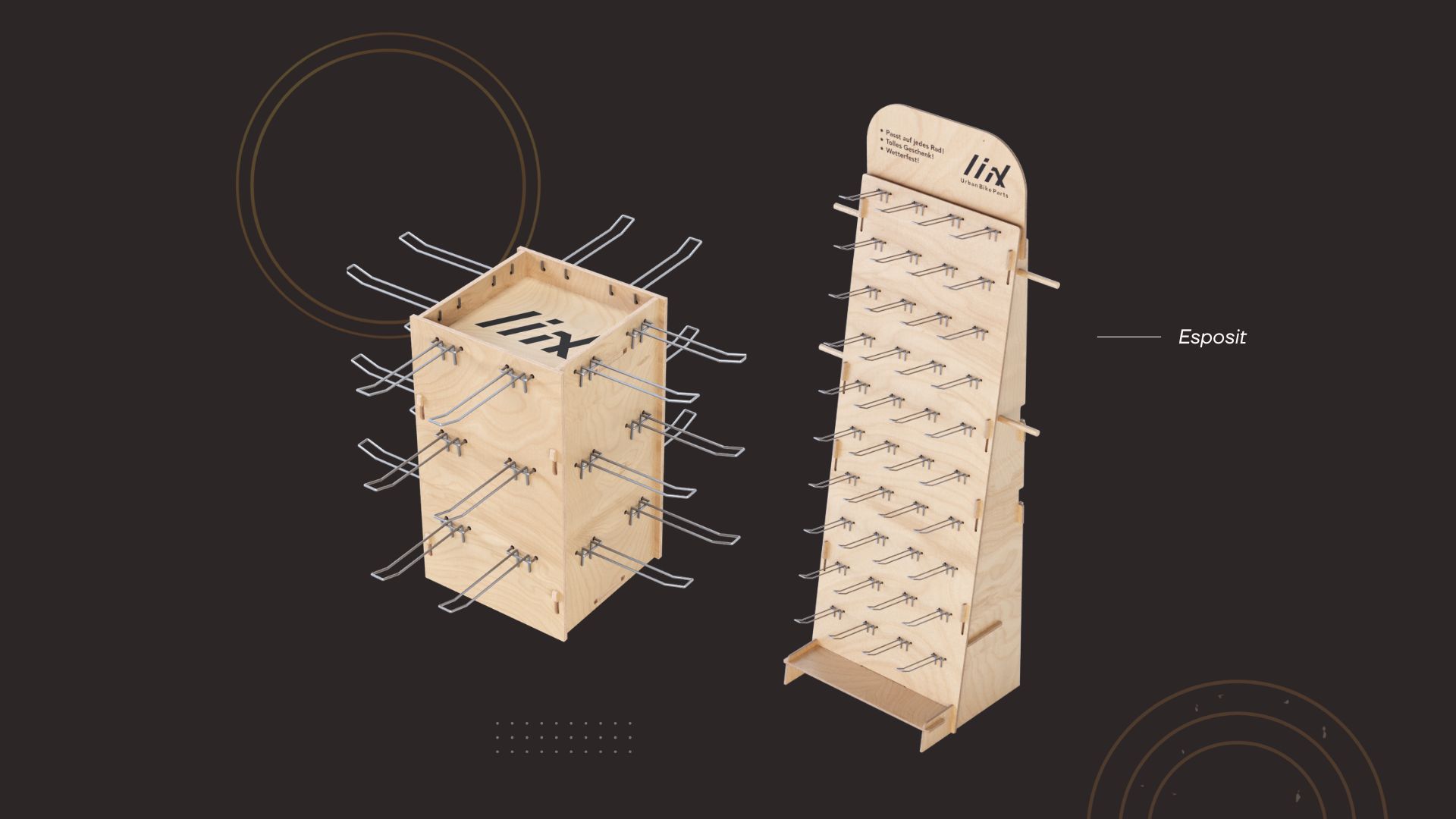
To best showcase the bells and the wide range of Liix products, it was necessary to design a retail display of substantial size: approximately 1.95 metres high, with a central body 63 centimetres wide and a total width that can reach up to 90 centimetres thanks to the inclusion of wooden side elements. The structure is designed to hold 40 metal hooks, making the most of every available centimetre for display and ensuring a neat and immediately recognisable presence within the retail outlet.
In a floor display of this size, however, the real complexity does not just concern design and display capacity: it is above all about logistics. Shipping a single-piece display stand almost two metres high means, in fact, resorting to out-of-gauge packaging, take up a significant portion of the height of standard pallets and considerably increase transport costs.
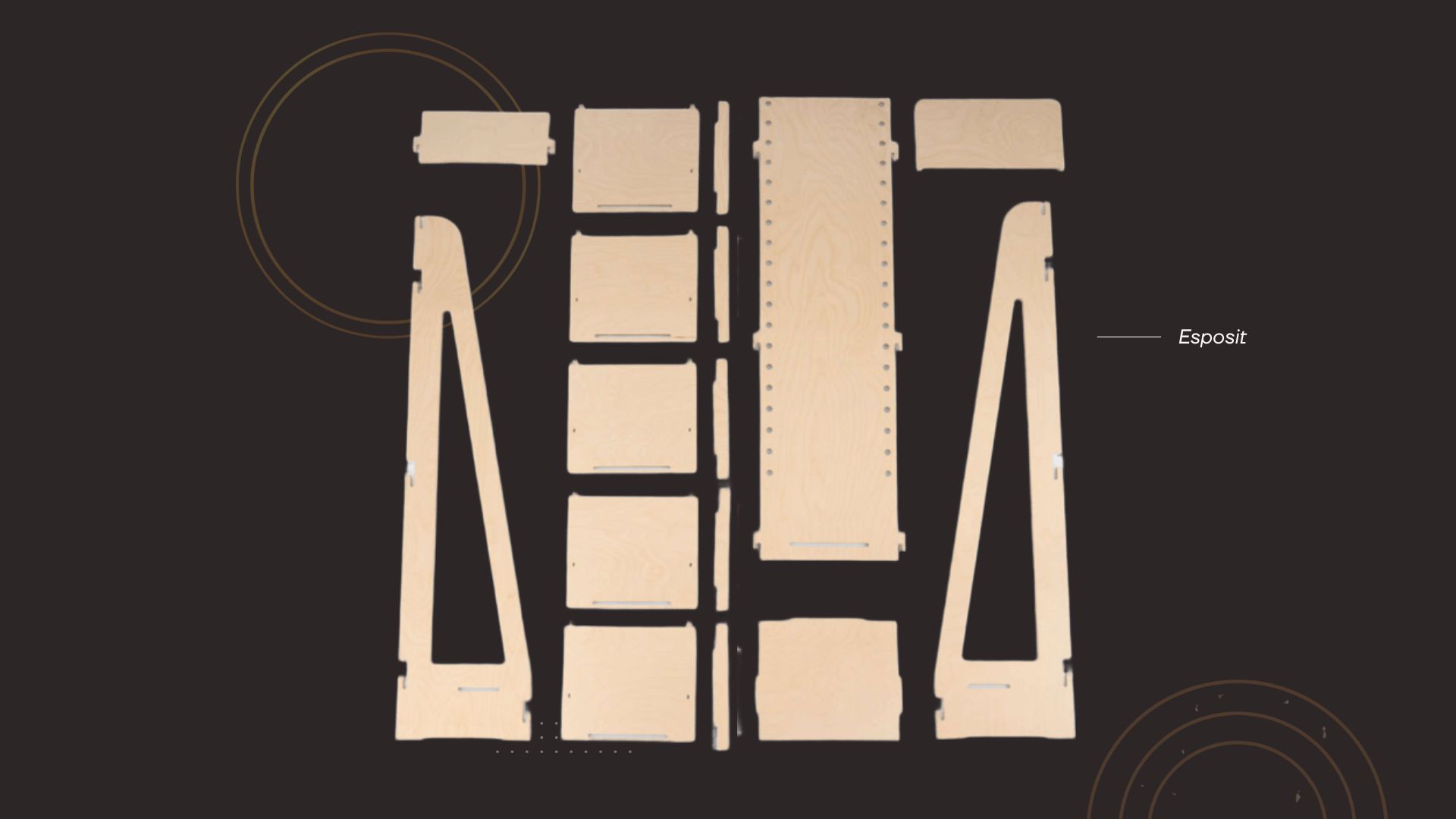
For this reason we tackled the problem directly during the design phase, developing a modular display stand that can be disassembled into elements with a maximum dimension of one metre.
The result is a structure that, once assembled in the store, exceeds two metres in height yet can be conveniently transported inside flat-pack boxes, stored on a single standard pallet. In this way, the retail display design is not limited to meeting the aesthetic and functional requirements of the point of sale, but takes into account the entire logistical cycle of the product.
THE SECRET OF THE INTERLOCKING JOINTS
Dividing a two-metre-high shop display unit without resorting to screws or metal components could have compromised the structural rigidity in the central area. To prevent this, we designed the side panels and front panels so that weren't divided at the same height. This is where the rear back panel of the display stand comes into play: positioned exactly at the junction of the sides, it locks simultaneously into the top and bottom sections, connecting the two modules and transforming them into a single structure. To complete the system, the front panels dedicated to product display come into play. The whole creates a system of interlocking parts in which each component helps to constrain and reinforce the others.
The result is a structure that maintains the same rigidity and stability as a display stand made in a single piece. Even when moved or subjected to lateral pressure, the display remains stable and wobble-free. A design and engineering solution for display stands where the structure itself becomes an integral part of the assembly system.
MODULARITY AND DETAILS FOR A FLEXIBLE DISPLAY
To extend the width of the display stand up to 90 centimetres, we have introduced shaped wooden rods that visually evoke the bicycle handlebars and which allow additional products to be hung. Their function is exclusively display-based and not structural. If the store has less space available, the side panels can be removed in a few seconds without compromising the stability of the display stand.
The same logic was applied to the upper headtube bearing cover featuring the Liix brand, designed as element independent of the frame.
This choice makes the modular display stand easily updateable over time: if the brand introduces a new visual identity, a new collection or seasonal communication, it is enough to replace the header panel without touching the entire structure.
The result is a retail display flexible and reusable, designed to adapt to the evolution of the brand and the different needs of the store.
THE COMPACT AND SWIVEL COUNTERTOP SOLUTION
To complete the Liix display system, a countertop version has been developed, designed to bring the same design logic into more compact spaces. The display has a 30 × 30 centimetre base and a total height of 54 centimetres. Built on a revolving base, it makes use of all four sides to hold up to 24 hooks, six on each side.
The rotation allows the customer to explore the entire range of small accessories with a simple gesture, increasing product visibility without taking up a significant surface area. In this case too, The display stand design stems from the observation of the in-store experience.
Given the low height of the structure and the overhead perspective of anyone standing in front of the counter, a traditional projecting header would have visually weighed down the display. We therefore chose to integrate the branding directly into the top surface, recessing the Liix logo into the surface and making it visible from all four sides.
A solution that keeps the retail display light and clean, leaving the product at the centre of attention and integrating brand communication directly into the structure.
RETAIL DISPLAY DESIGNED FOR THE POINT OF SALE AND LOGISTICS
The Liix project demonstrates how retail display design must go beyond mere aesthetics.
Dimensions, display capacity, modularity, assembly, transport and upgrade potential must be considered as parts of a single process design. In this case, a floor display stand almost two metres high was transformed into an easily transportable modular system, while the interlocking system guarantees stability and simplicity of assembly.
The result is a retail design project in which aesthetics, functionality and logistics work together to respond to the practical needs of the retail store and the brand.