



Designing a book display means finding a balance between exhibitionist ability, stability, functionality and brand identity. For Ilisso Editions, Esposit, a publishing house dedicated to the promotion of culture and editorial heritage, has developed a custom rotating display through a design process that involved four prototypes. A project that tells the story of the value of Esposit MethodStarting from the concrete needs of the customer, verifying them through technical development and arriving at a solution designed to meet the real conditions of use.
Designing the exhibition of culture
In the name Ilisso Editions There is a reference that recalls the movement of thought, cultural exchange, and the continuity between the past and the present. The Ilisso River, from which the publishing house takes its name, thus becomes a symbol of the flow of ideas that permeates culture and transforms it.
From this identity comes a precise design challenge: How to exhibit books that, in addition to being published by publishing houses, are cultural objects with different formats, sizes and weights?
The request did not simply concern the creation of a book display stand but the development of a structure capable of enhancing the volumes, containing an adequate number of them and ensuring stability during use. The answer was a four-sided rotating display stand, designed to measure exactly Ilisso Editions and developed through a process of comparison, verification and progressive refinement.
From the product catalog to the customized project
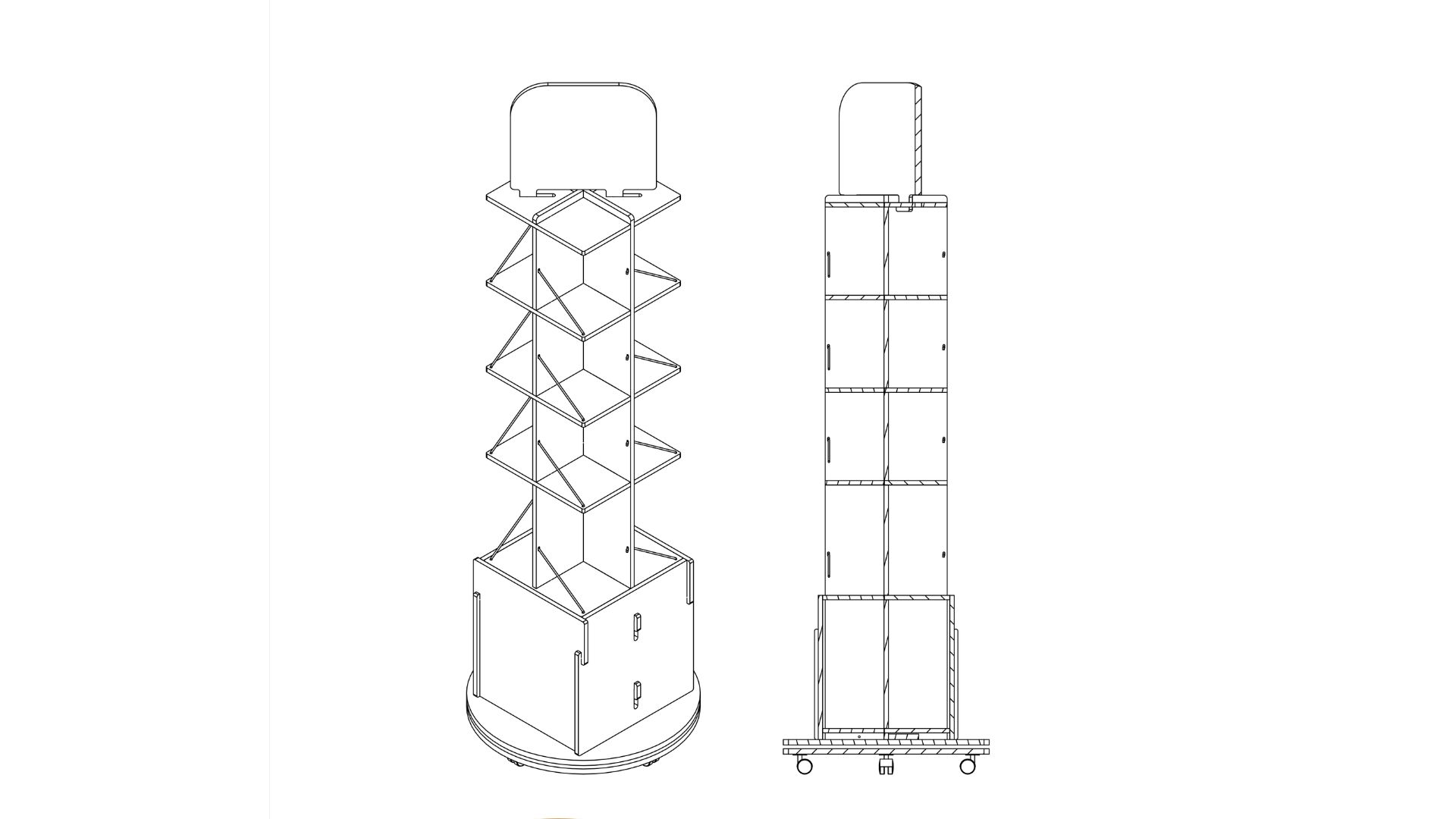
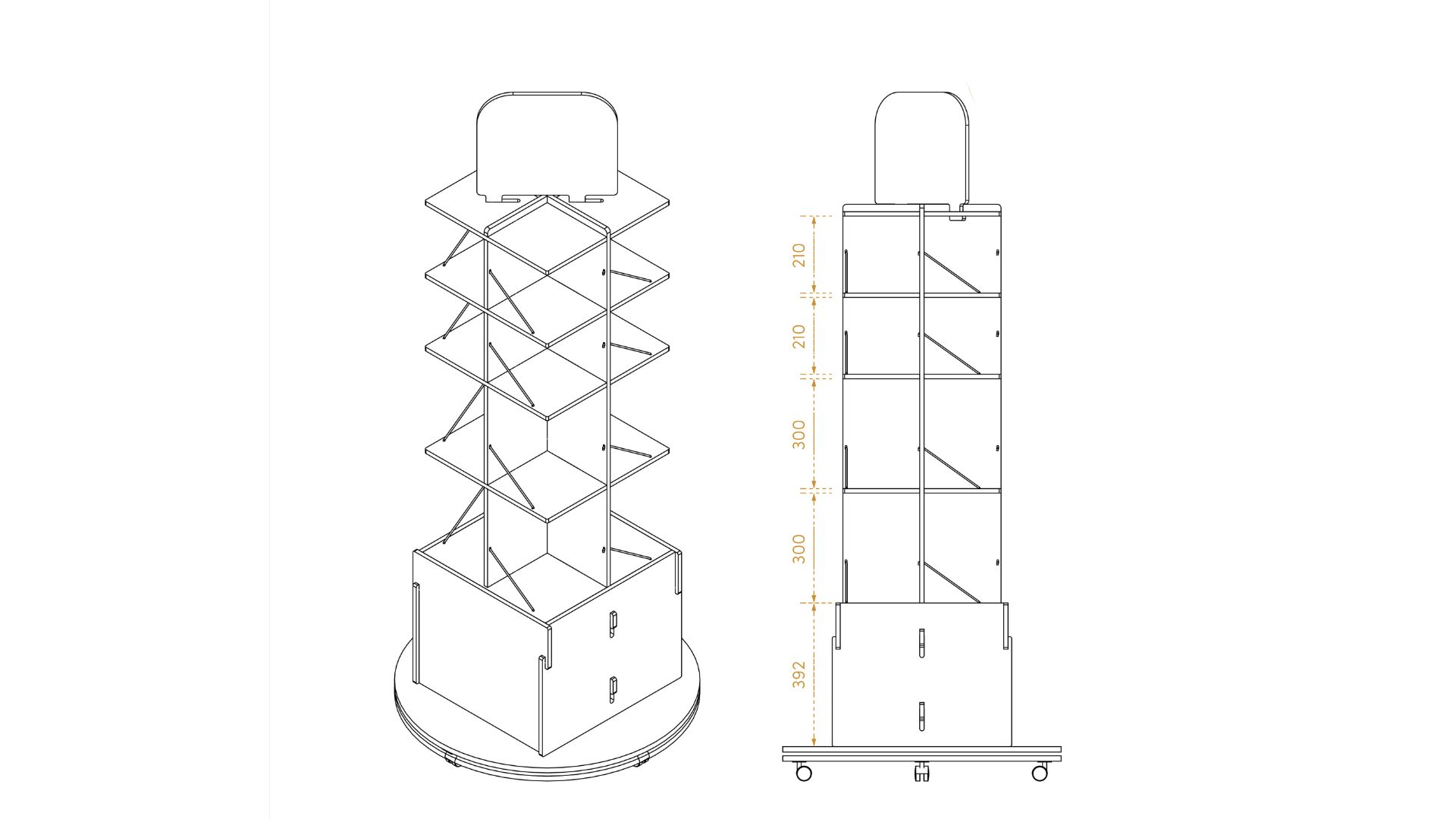
The project began in June 2024. The starting point was the model. Avo Max, a 360° rotating display stand with integrated container compartment, initially identified on the Esposit website.
The analysis of the characteristics of the books and the space required to display them highlighted the limitations of the standard configuration. The first hypothesis therefore envisaged four shelves of different heights: 30 cm for the lower ones and 21 cm for the upper ones. However, even this configuration, it did not guarantee the exhibition space required.
It was necessary to rethink the project in a broader way, overcoming the constraints of the initial structure and developing a specific solution. A step that expresses one of the principles of the Esposit Method: not forcibly adapting an existing product but evaluate how to develop the solution that best meets the need.
Four prototypes to develop a custom rotating display stand
The design process required four phases of development, including preliminary configurations, physical samples, and structural modifications. Each step allowed for the verification of critical aspects and the introduction of targeted improvements.
1. The second prototype: increasing the exhibition space
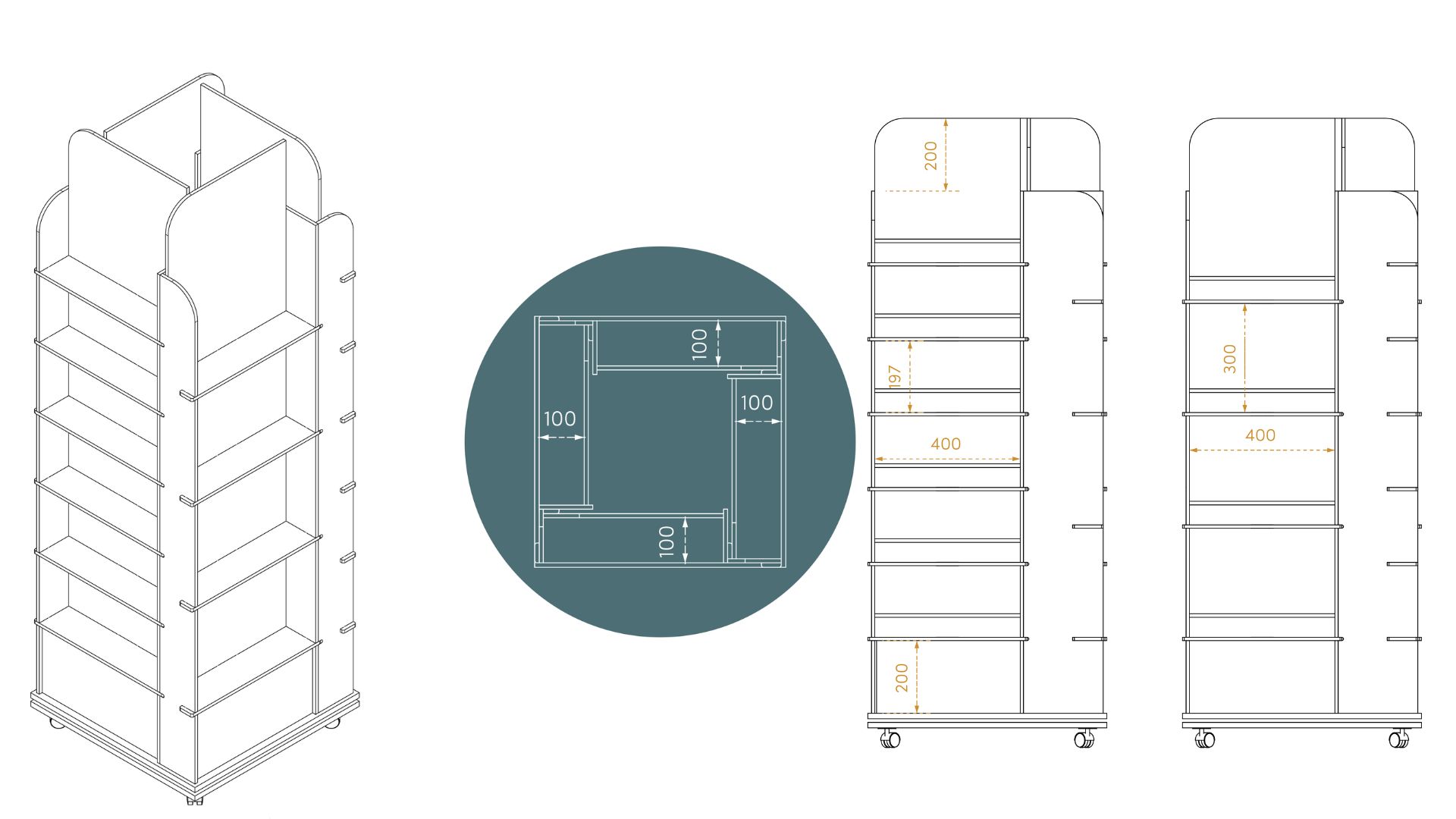
The first design evolution involved eliminating the container compartment at the base and a new distribution of the shelves on the four rotating sides. The structure featured two pairs of opposing sides with different configurations: two sides with six shelves 20 cm high and 40 cm long, and two sides with four shelves 30 cm high and 40 cm long. The depth of all the shelves was 10 cm. Additionally, four customizable test stands were introduced, instead of just one, to expand the possibilities for identifying the brand. This solution, although never produced, contributed to defining the distribution of space and the characteristics of the subsequent development.
2. The first physical champion: greater depth and greater stability
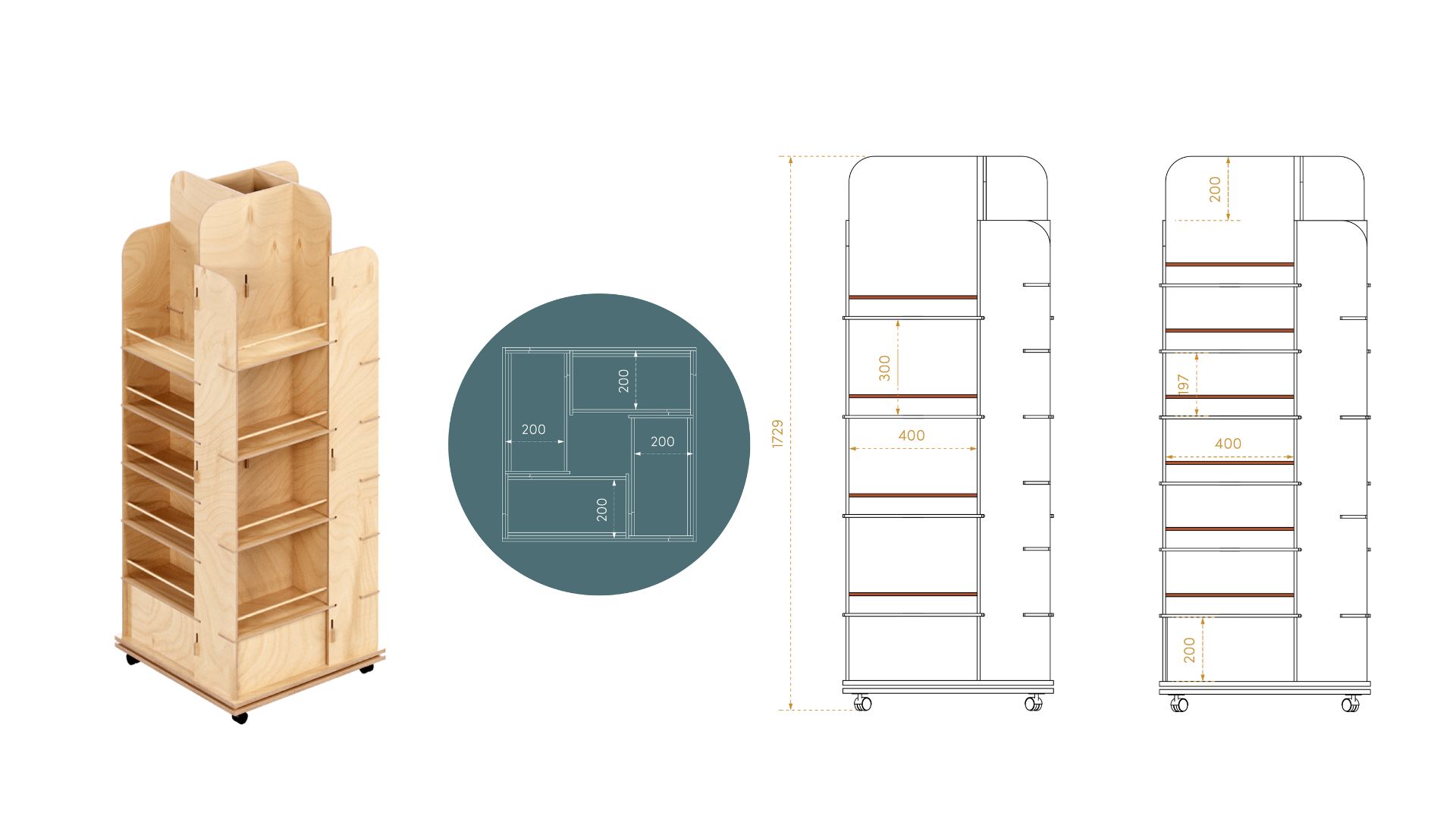
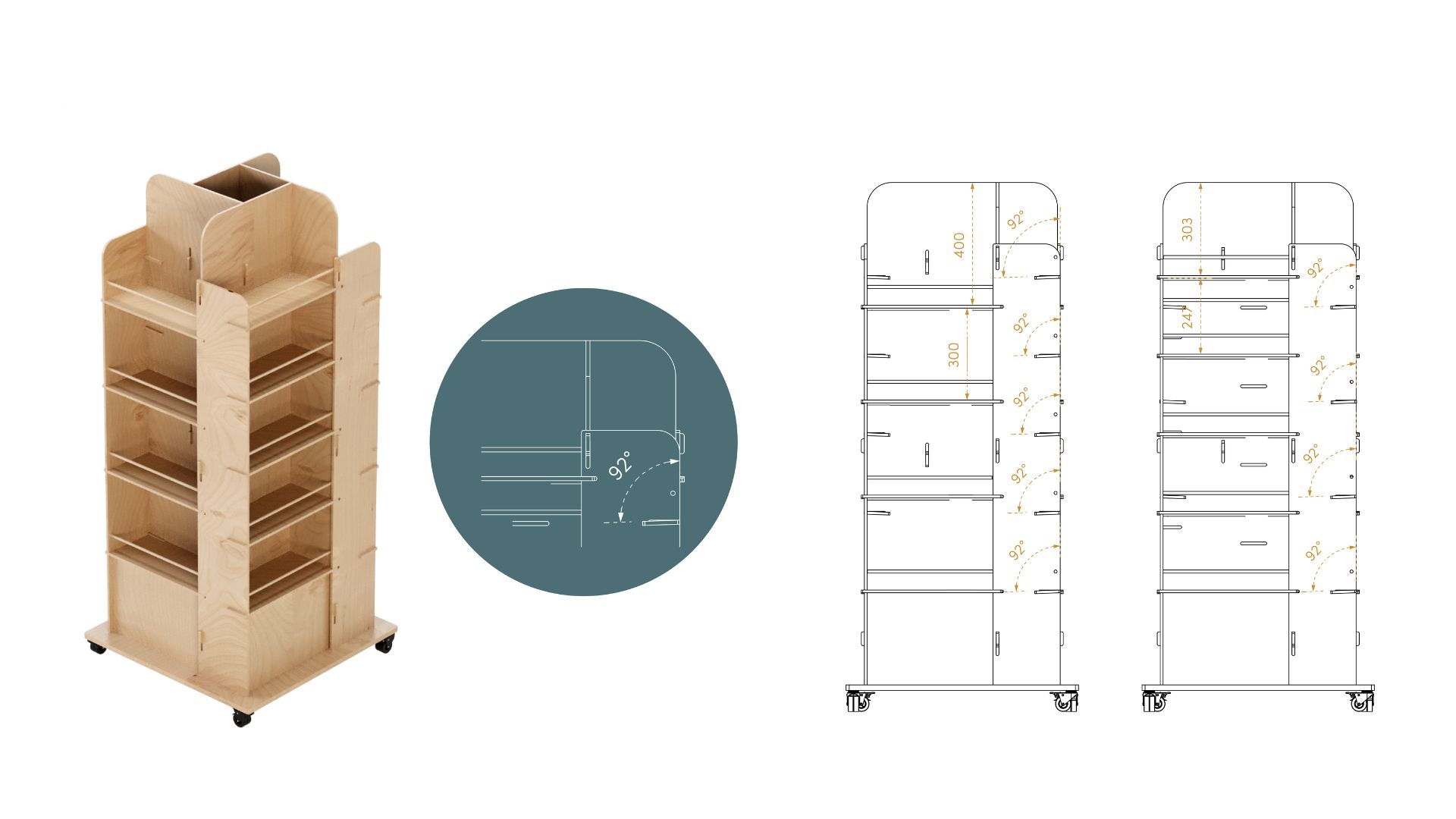
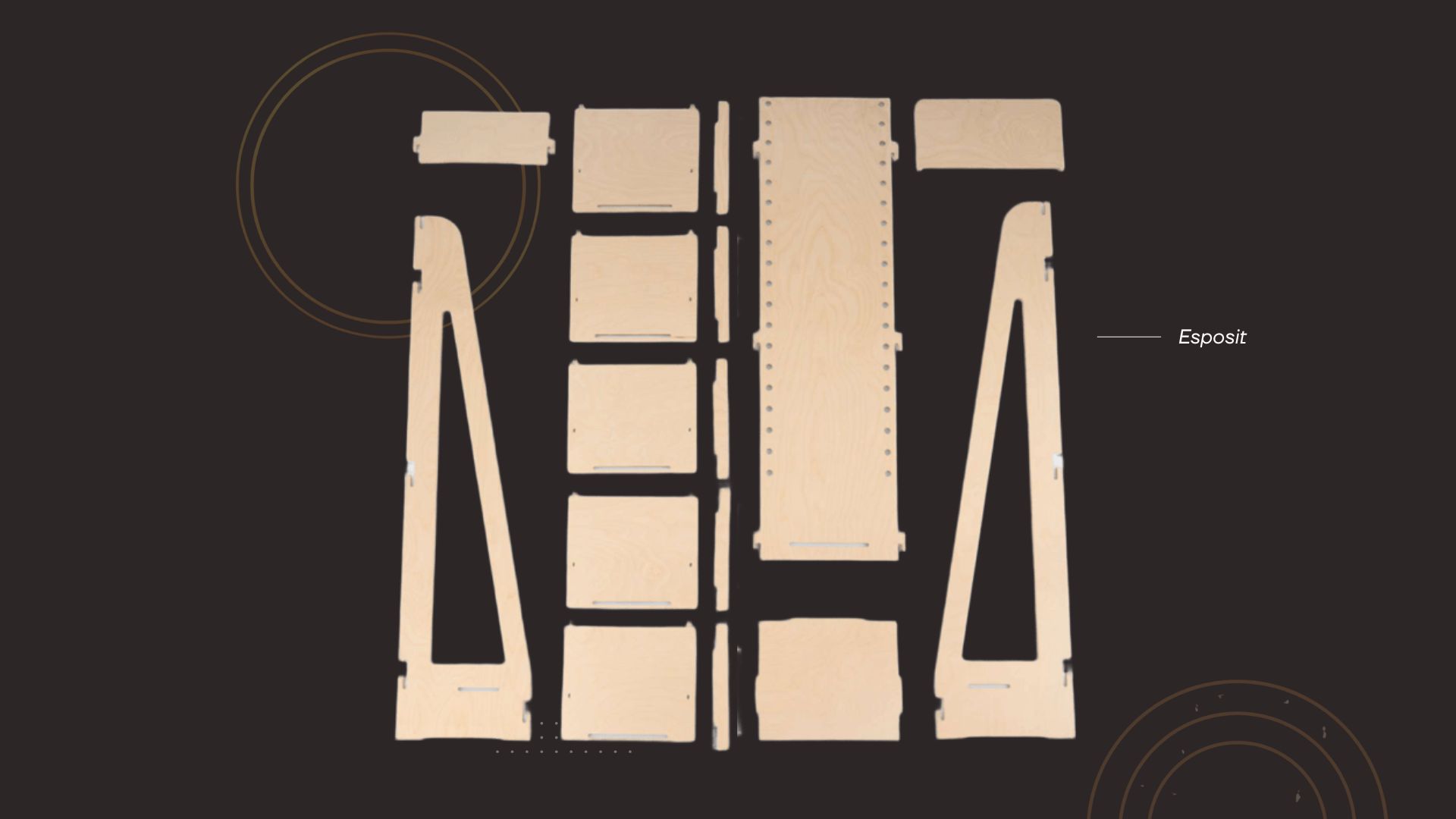
With the first physical sample, the project entered the phase of concrete verification. The analysis of the configuration highlighted the need to increase the depth of the shelves and improve the containment of the books. The depth was therefore doubled, going from 10 to 20 cm, while holes were introduced in the sides to accommodate protective bars, useful for holding the volumes. The construction details were also carefully studied. In line with the Philosophy Exhibition, The structure left the necessary gaps between the shelves visible, concealing those on the backs instead, in order to maintain a visually ordered result. The sample reached a height of 172 cm and a weight of 38 kg. Despite its size, the structure was designed to be supplied in flat-pack configuration facilitating transportation and on-site assembly.
3. The second physical measure: the importance of two degrees
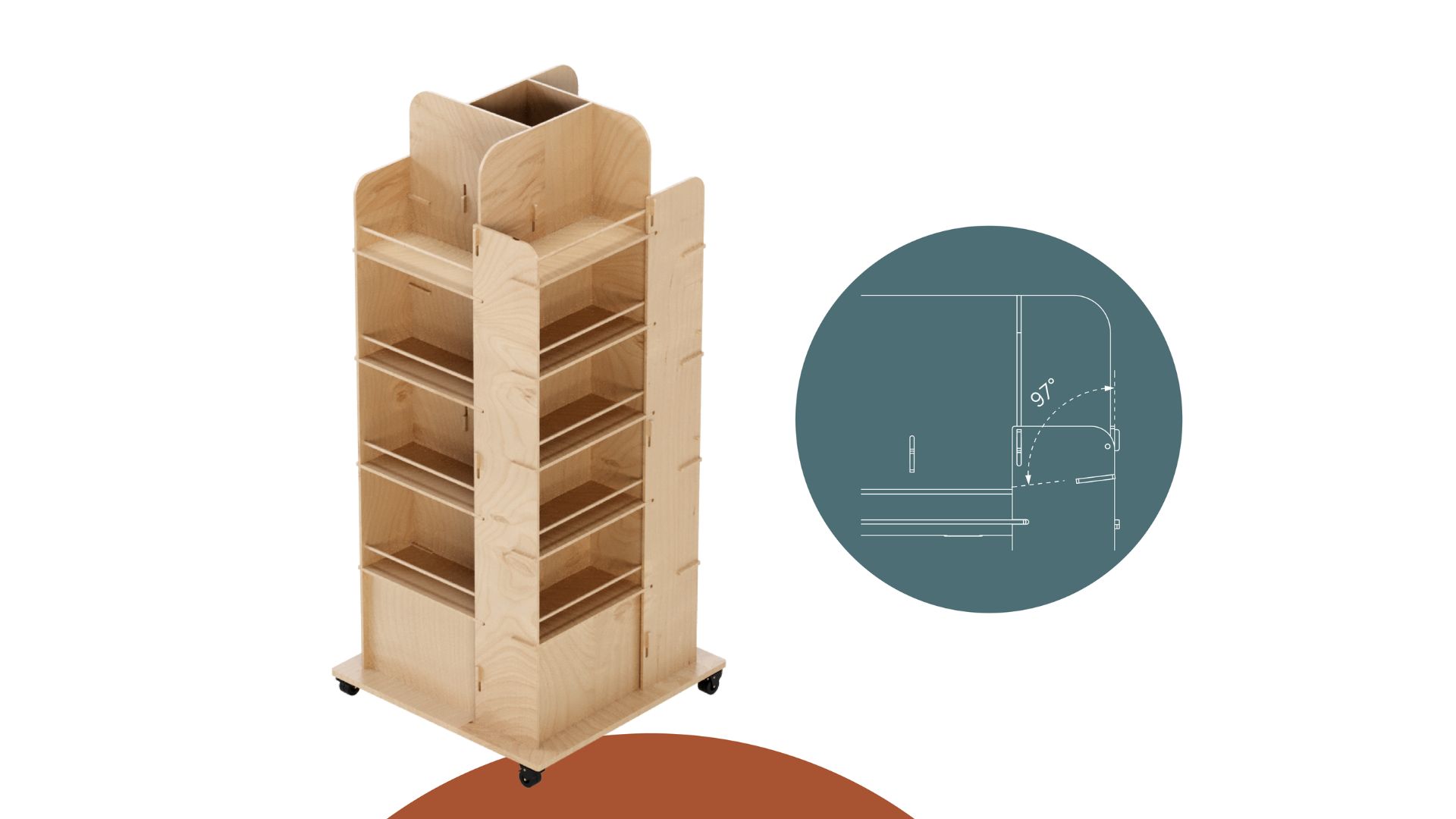
The second physical prototype introduced further modifications to the distribution of the shelves and the base’s dimensions, which were lengthened by 10 cm. The four faces maintained two different configurations: two sides with five shelves, four high 25 cm and one upper with a 30 cm high testal; the other two had four shelves high 30 cm and a 40 cm high testal. However, the most significant modification concerned the’inclination of the shelves, initially set to 2 degrees towards the back of the chair. This choice was in response to a practical need: when a book is picked up, the slight inclination helps the other volumes shift towards the bottom, helping to keep them in place and to prevent them from falling over. reduce the risk that they will swing too far ahead.
A seemingly minor detail, but important for improving the functionality of the display during daily use.
4. The final model: 180 cm tall and 7 degrees of inclination
Based on the verification of the second physical sample, the final structural modifications have been made. The overall height has been increased by an additional 8 cm to reach 180 cm, giving greater presence to the structure and meeting the project’s requirements. The inclination of the shelves has also been further modified: An additional 5 degrees were added to the initial 2 degrees, bringing the total tilt towards the backrest to 7 degrees. These interventions led to the final configuration: a four-sided rotating display stand, developed specifically for Ilisso Editions and was made in 21 copies.
The result combines exhibitionist capabilities, stability and attention to construction details while maintaining the flat-pack logic that characterizes the Esposit solutions.
The value of dialogue in the design of personalized displays
The case Ilisso Editions highlights a central aspect of Esposit’s work: the relationship between the client and the developer of the solution. Important factors, different editorial formats and the need for concrete use have required verification and changes throughout the process. Continuous dialogue has enabled the identification of areas for improvement and the translation of initial requirements into precise design choices. The value of Esposit Method That is precisely what it is: to relate needs, design and production without considering the first hypothesis as necessarily definitive.
For Saglietti Group and Esposit, fulfilling the need means starting from what is really needed, developing the solution together with the customer, and verify its functionality before reaching the final product. The result is not simply a customized display stand but a structure designed around books, their use, and the identity of those who publish them.
Do you need a book display stand or a customized display system?
Esposit develops wooden displays, displays and modular furniture for retail and exhibition spaces, starting from the characteristics of the project and the needs of use.